

Electrofishing the end of a Cape Race stream before it tumbles down a waterfall into the North Atlantic.
The long-term study of salmonid fish populations at Cape Race, Newfoundland was founded by the late Dr. Jeffrey Hutchings in the late 1980s. Since 2010, a dedicated crew from our lab travels to Cape Race annually in the summer (and most autumns) to carry out a series of research studies on the ecology, evolution, genetics and genomics of the fish. Our team studies a minimum of 11 trout populations annually but at various times we have expanded the spatial sampling to include up to 30 trout populations and the unique dwarf landlocked Atlantic salmon found in a few streams. We have several hundred mark-recapture estimates of individual population abundances, 10,000s of body size measurements, life history and heritability data, stream temperature and flow data, and 10,000s of tissue samples for genetic/genomic research on various age classes.

For Cape Race standards, this brook trout is a MONSTER!
The long-term dataset we have generated on the system and several attributes of Cape Race salmonid populations provide an exceptional opportunity for evolutionary ecologists and conservation biologists to address timely questions including, but not limited to adaptation to environmental change, mechanisms underpinning small population dynamics, phenotypic and demographic responses to climate change, the role of intraspecific variation in portfolio effects, and density dependence. As the long-term dataset at Cape Race expands, we see how it offers the opportunity to satisfy a rich array of research interests, whether for longer-term studies with decades of data or for shorter-term projects on specific questions. Postdocs, graduate students and undergraduate students are encouraged to contact Dylan Fraser if they are interested in studying or collaborating on the Cape Race study.
Some of the attributes that make Cape Race such an amazing place to research the ecology, evolution or genetics of salmonid fishes:
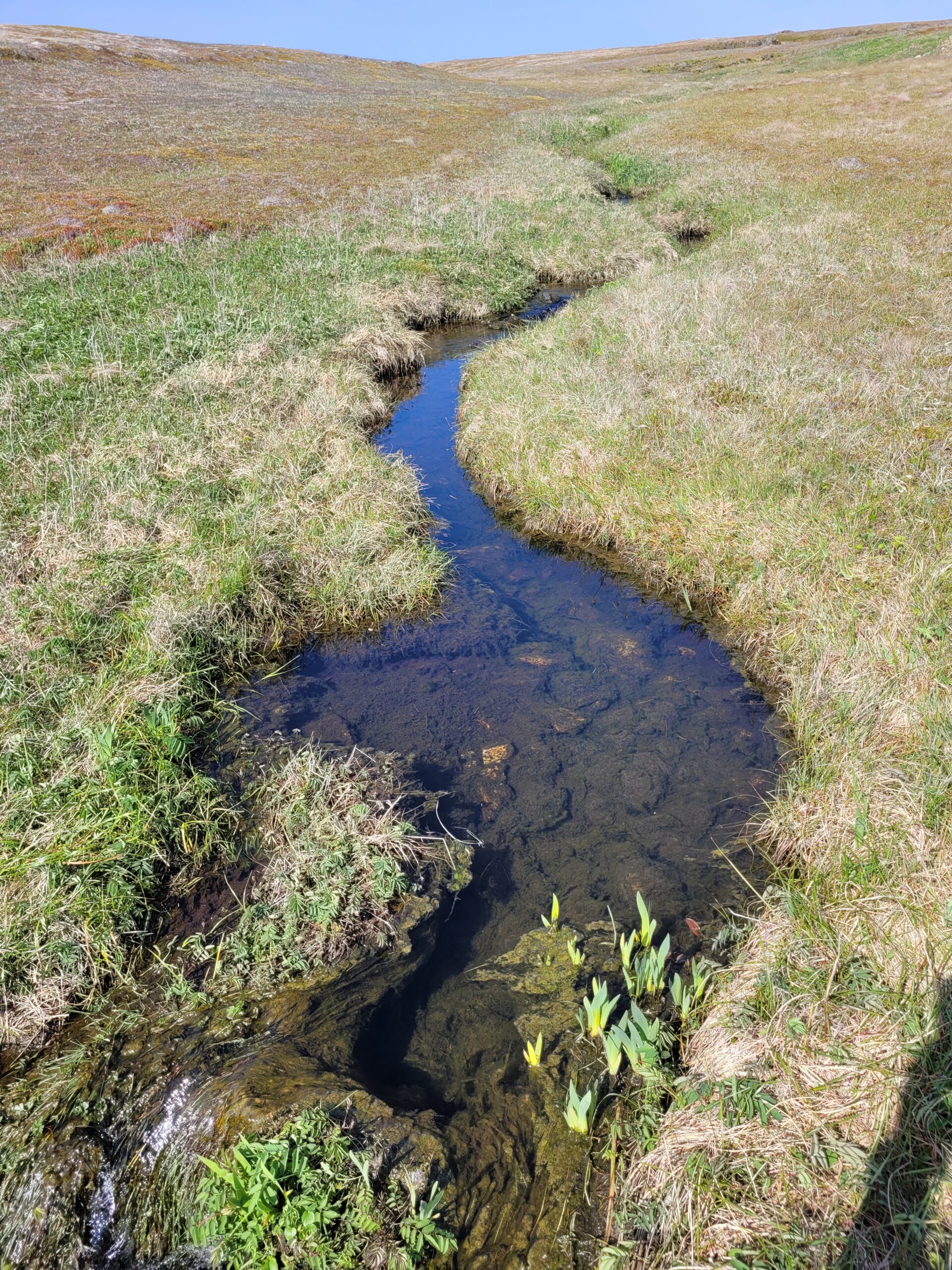
This groundwater-fed stream is 250m in length and supports an abundance of 300-400 brook trout
1) The fish inhabit small streams and hence can be comprehensively sampled, both in the field directly (habitat, population size, movement, life stages etc.), for population genetics/genomics studies, for study in a wetlab setting (common garden experimentation on their quantitative genetics and phenotypic plasticity) and for tightly controlled experimental translocations in nature. We have been able to rear up to 9 brook trout populations simultaneously under common environmental conditions, to generate some of the largest such studies on salmonid fishes..and vertebrates!
2) The fish populations can be easily demarcated with genetic tools, and population isolation can be confirmed (this is difficult in many taxa/instances). This differentiation occurs at a fine-geographic scale (25km2), providing the opportunity to investigate the causes and consequences of microgeographic variation in phenotypic variation, genetic variation and demography.
3) The fish populations here vary in abundance by four orders of magnitude (10s to 10000s), and three orders of magnitude in effective population size (10s to 1000s), making them a great model to contrast small vs. large population dynamics and the role that effective population size may have on shaping adaptive responses.
4) The brook trout populations originate from a common ancestor and became isolated abruptly after the last deglaciation, i.e. their evolutionary history can be feasibly teased apart.
5) The fish populations are essentially pristine; fish species – especially salmonid fishes – have a history of being transplanted/stocked everywhere, but not here, probably because the small size of Cape Race salmonids and the relative remoteness of the populations has not resulted in anthropogenic disturbance.

A typical ‘dwarf’ landlocked Atlantic salmon from Cape Race
6) The landlocked Atlantic salmon of Cape Race are the smallest known mature adults in the world (commonly 3-5” long!), offering a unique opportunity to understand the evolution of dramatic body size changes in vertebrate species, and its consequences for maternal investment, maturation and adaptation.
7) Brook trout and Atlantic salmon are a member of one of the world’s most socio-economically important fish families, salmonids (salmon, trout, charr); research results on Cape Race populations have a direct bearing on conservation and management strategies/considerations for these species.
And Cape Race is a beautiful place to conduct field research!
Associated research papers (*supervised or co-supervised students):
*Jeon H-B (Postdoc), MC Yates (Postdoc)*, B Gallagher (PhD)*, DJ Fraser (2025) Life’s a ditch: genomic signatures of adaptive evolution and purging in extremely small stream populations of brook trout. Canadian Journal of Fisheries and Aquatic Sciences.
*Matte JM (Postdoc), DJ Fraser, JWA Grant (2024) Stock-recruitment relationships among populations of a stream salmonid: comparisons with classic case studies. Journal of Fish Biology
*Gallagher B (PhD), DJ Fraser (2024) Microgeographic variation in demography and thermal regimes stabilize regional abundance of a widespread freshwater fish. Ecological Applications
*Gallagher B (PhD), DJ Fraser (2024) Stream groundwater inputs generate fine-scale variation in phenology and growth among brook trout populations. Freshwater Biology
*Matte J-M (PhD), DJ Fraser, JWA Grant (2021) Mechanisms of density dependence in juvenile salmonids: prey depletion, competition, or energy expenditure? Ecosphere.
*Yates MC (PhD), DJ Fraser (2021) Evaluating the correlation between genome-wide diversity and the release of phenotypic variation in experimental translocations to novel natural environments. Journal of Evolutionary Biology.
*Matte J-M (PhD), DJ Fraser, JWA Grant (2020) Population variation in density-dependent growth, mortality and their trade-off in a stream fish. Journal of Animal Ecology 89:541-552.
*Yates MC (PhD), E Bowles (Postdoc), DJ Fraser (2019) Small population size and low genomic diversity have no effects on fitness in experimental translocations of a stream fish. Proceedings of the Royal Society of London Biological Sciences 286:20191989.
Fraser DJ, L Walker (BSc)*, MC Yates (PhD)*, K Marin (MSc)*, JLA Wood (PhD)*, C Zastavniouk (MSc)*, T Bernos (MSc)* (2019) Population correlates of rapid captive-induced maladaptation in a wild fish. Evolutionary Applications 12: 1305-1317.
*Wells, ZRR (MSc), TA Bernos (MSc), MC Yates (PhD), DJ Fraser (2019) Genetic rescue insights from population- and family-level hybridization effects in brook trout. Conservation Genetics 20: 851-863.
*Bernos T (MSc), MC Yates (PhD)*, DJ Fraser (2018) Fine scale differences in genetic and census population size ratios between two stream fishes. Conservation Genetics 19: 265-274.
*Zastavniouk C (MSc), LK Weir, DJ Fraser (2017) The evolutionary consequences of habitat fragmentation: differentiation in body morphology and colouration among brook trout populations of varying size. Ecology and Evolution 7: 6850-6862.
*Wells ZRR (MSc), L McDonnell, L Chapman, DJ Fraser (2016) Limited variability in upper thermal tolerance among pure and hybrid populations of a cold water fish. Conservation Physiology 4: cow063.
*Bernos TA (MSc), DJ Fraser (2016) Spatiotemporal relationship between adult census size and genetic population size across a wide population size gradient. Molecular Ecology 25: 4472-4487. PDF
*Wood JLA (PhD), MC Yates (PhD)*, DJ Fraser (2016) Are selection and heritability related to population size in nature? Meta-analysis and conservation implications. Evolutionary Applications 9: 640-657. PDF
*Wood JLA (PhD), D Tezel (BSc)*, D Joyal (BSc)*, DJ Fraser (2015) Population size is weakly associated with quantitative genetic variation and trait differentiation in a stream fish. Evolution 69: 2303-2318. PDF
*Wood JLA (PhD), DJ Fraser (2015) Similar plastic responses to elevated temperature among different-sized brook trout populations. Ecology 96: 1010 – 1019. PDF
Fraser DJ, PV Debes (Postdoc)*, L Bernatchez, JA Hutchings (2014) Population size, habitat fragmentation, and the nature of adaptive variation in a stream fish. Proceedings of the Royal Society of London Biological Sciences 281:20140370. PDF
*Yates MC (PhD), DJ Fraser (2014) Does source population size affect performance in new environments? Evolutionary Applications 7: 871 – 882. PDF
*Wood JLA (PhD), S Belmar-Lucero (MSc)*, JA Hutchings, DJ Fraser (2014) Relationship of habitat variability to population size in a stream fish. Ecological Applications 24: 1085-1100. PDF
*Belmar-Lucero S (MSc), JLA Wood* (PhD), S Scott* (BSc), AB Harbicht* (MSc), JA Hutchings, DJ Fraser (2012) Concurrent habitat and life history influences on effective/census population ratios in stream-dwelling trout. Ecology and Evolution 2: 562-573. PDF
